Things to Do in Dhaka
Painted rickshaws, river fog, and biryani that justifies everything
Top Things to Do in Dhaka
Find activities and tours you'll actually want to do. Book through our partners -- no booking fees.


Plan Your Trip
Essential guides for timing and budgeting
Climate Guide
Best times to visit based on weather and events
View guide →Day Trips
The best excursions and nearby destinations worth the journey
Explore day trips →Where to Stay
Best neighbourhoods, hotel picks, and booking tips
Find hotels →Travel Insurance
What's required, what coverage matters, and how to get a quote
Read guide →What to Pack
Climate-specific gear, essentials, and what to leave at home
See packing list →When Should You Visit Dhaka?
Tap a month for weather, crowds, and highlights
View full year-round climate guide →

Your Guide to Dhaka
About Dhaka
Dhaka refuses to greet you. It slams you. The air arrives first: thick, damp, freighted with woodsmoke from roadside tea stalls and the faint, sweet rot of the Buriganga River slicing the city's southern edge. Then the sound, which never quits. Rickshaw bells layer over the call to prayer from a thousand mosques, the low diesel growl of buses painted in colors no transit authority would approve.
This is a city of more than twenty million people packed into a space that might comfortably hold five million, and that compression is what makes Dhaka unlike anywhere else you have been. Old Dhaka is the core. Shakhari Bazar, a lane barely wide enough for two people to pass, has been the Hindu conch-shell workers' quarter for four hundred years, and the click-tap of artisans carving bangles from shell still sounds exactly as it did under the Mughals.
Around the corner, Lalbagh Fort sits unfinished since 1684, its walls stained green with monsoon moss, the tomb of Pari Bibi catching afternoon light through latticed stone. Walk south to Sadarghat, the river terminal, and watch the controlled pandemonium of wooden launches, rusting ferries, and cargo boats fighting for dock space.
Likely the most visually overwhelming port scene in South Asia. The newer city, Gulshan, Banani, Dhanmondi, runs on a different clock: air-conditioned cafes, rooftop restaurants, ride-hailing apps that work on the first try. The distance between these two Dhakas is a fifteen-minute drive that will, in Dhaka traffic, take an hour.
You come here for the chaos. You stay because the kacchi biryani at Haji Biriyani near Chowk Bazar, mutton slow-cooked under a dough-sealed lid, the rice stained yellow with saffron, whole spices crackling between your teeth, is reason enough to tolerate a city that will redefine what you thought crowded meant.
Travel Tips
Transportation: Dhaka's traffic is legendarily bad, and that is not a travel-writer flourish. The CNG auto-rickshaw is your workhorse for anything over a kilometer. Always insist on the meter, because the opening quote for a foreign face is inflated as a matter of course. For shorter hops, cycle rickshaws beat any engine in gridlocked traffic. The hand-painted panels on each one, film scenes, tigers, Bollywood knockoffs, are an art form you will not find at this scale anywhere else. Pathao is the local ride-hailing app and tends to work more reliably than Uber in Dhaka. Download it before you land. Avoid public buses unless you enjoy being compressed into spaces that defy physics. The river launches from Sadarghat remain the most underused way to move through the southern districts.
Money: Cash still runs most of Dhaka. ATMs cluster in Gulshan and Banani but thin out fast once you cross into Old Dhaka, so withdraw what you need before heading south. bKash, the mobile payment platform, is everywhere: street food carts, rickshaw drivers, pharmacies. Loading an account at any agent kiosk takes minutes with your passport. Credit cards work at upscale spots in Gulshan and Dhanmondi but draw blank stares at tea stalls. The airport exchange counter offers poor rates. You will do noticeably better at any bank branch in the Motijheel commercial district. Carry smaller denominations, because breaking large notes at street vendors is a negotiation in itself.
Cultural Respect: Bangladesh is a Muslim-majority country, and Dhaka reflects that in daily rhythm. Cover shoulders and knees, both men and women, in Old Dhaka and around mosques. Shoes come off before entering any mosque or home. There is always a pile at the door to signal the expectation. Eat and greet with the right hand. The left is considered unclean. During Ramadan, which shifts earlier each year on the Gregorian calendar, eating or drinking publicly during daylight hours is disrespectful even for non-Muslims. Bangladeshis are remarkably hospitable to visitors. Expect tea invitations from strangers that are genuine, not setups. Accept one. It will be the sweetest, milkiest tea you have ever tasted, served in a glass barely bigger than a thimble, poured from a kettle that has been steeping since dawn.
Food Safety: Start in Old Dhaka and do not be timid. The kacchi biryani at Haji Biriyani near Chowk Bazar is the benchmark: mutton slow-cooked under a dough-sealed lid, the rice fragrant with saffron, cardamom pods and whole cloves crackling between your teeth. Fuchka from the evening carts along Dhanmondi Lake, tamarind water sharper than its cousins elsewhere in South Asia, the filling carrying a slow-building chili heat, is cheap and extraordinary. The one hard rule: drink only sealed bottled water and skip the ice in street-side drinks. Tap water will cost you a lost day. The lassi stalls in Bangshal pour thick, tangy yogurt drinks in unglazed clay cups that add an earthy mineral finish no glass can replicate.
When to Visit
Dhaka's climate splits into three seasons, and picking the wrong one is the difference between a trip you talk about and one you endure. November through February is the window. Temperatures settle between 12 and 25 degrees Celsius (54 to 77 Fahrenheit), the humidity drops to something a human body can process, and the sky clears to the pale, washed-out blue that Dhaka only manages a few months a year.
Morning fog hangs over the Buriganga, burning off by mid-morning, and evenings cool enough for walking without arriving somewhere drenched. This is peak season, naturally, so hotel rates sit at their highest and domestic tourists crowd the major landmarks. But the trade-off is worth it. Pohela Falgun, the first day of spring in early February, fills the streets of Dhanmondi and the university campuses with yellow saris, marigold garlands, and live music drifting across the lake.
March through May is punishing. There is no softer way to put it. Temperatures push past 38 degrees Celsius (100 Fahrenheit) by April, and the humidity starts climbing toward monsoon levels before the rain arrives to break it. The air in Old Dhaka during a late-April afternoon feels like breathing through a wet towel. Hotel prices drop considerably, and you will have most sites largely to yourself.
But you pay in sweat-soaked shirts and shortened walking days. The nor'westers, sudden, violent thunderstorms rolling in from the northwest, offer brief, spectacular relief but flood streets in minutes and knock out power for hours. June through October is the monsoon, and Dhaka during the monsoon is something you either seek out or avoid entirely.
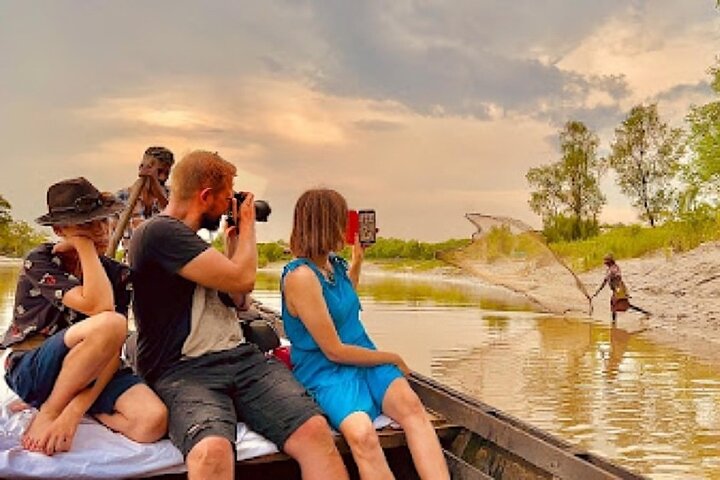
Rainfall commonly exceeds 300 millimeters per month between June and September, the Buriganga rises against its banks, and parts of low-lying Dhaka flood with a regularity the locals stopped remarking on years ago. Rickshaw rides become wading expeditions. The upside, and there is a real one: the city turns an almost violent shade of green, accommodation prices hit their lowest point of the year, and the light after a downpour, gold slicing through silver-grey clouds, is the kind of light photographers cross oceans for.
Eid al-Fitr and Eid al-Adha, which shift annually on the Islamic calendar, transform Dhaka more dramatically than any weather: half the population leaves for ancestral villages, and streets that normally take an hour to cross go silent in a way that feels post-apocalyptic. The honest advice is to come in November or December.
The weather is as kind as Dhaka gets, the winter cultural season is at its fullest, and you will want to walk, which is the only way Old Dhaka reveals itself. If you handle heat well, late February through early March gives you thinner crowds with temperatures still on the right side of bearable.
More Ways to Experience Dhaka
Tours, day trips, and local experiences curated by on-the-ground operators.
Didn't see anything interesting yet?
Browse Viator's full catalog of tours, day trips, food experiences, and private guides in Dhaka.
See All Dhaka Tours on Viator